
Verify La Mirada Voter Registration
The LA County Voter Registration Verification tool is the first stop for a La Mirada voter checking a current record. Enter all four requested facts, then submit the form to determine registration status. The county validates each entry closely. A last name must use letters only, the birth date must follow the stated month-day-year pattern, and both the house number and ZIP Code accept numbers only. If the form rejects a valid entry or produces no useful status, call the voter help line at (800) 815-2666, option 2.
| Lookup field | Input | Required | County rule |
|---|---|---|---|
| Last Name | Text | Yes | Alphabet only |
| Birthdate | Date/text | Yes | Use mm/dd/yyyy |
| House Number | Number | Yes | Numbers only; use the residence house number |
| Zip Code | Number | Yes | Numbers only |
| Submit/Search | Button | Yes | Checks the voter's registration status |
Use the details tied to the registration, not a mailing guess or a full street address. The house-number field wants only the numeric portion. The same county page links a voter to vote-by-mail status, a polling-place search, and other personal election services, but it does not release a full voter roll through the status form.
La Mirada Lookup Is Self-Verification
A common myth is that a voter status page works like a public people directory. LA County designed its tool for a person to confirm their own record. Requiring a birth date, exact house number, and ZIP Code keeps casual name browsing out of the workflow. Those fields also help separate residents who share a last name. A request for someone else's certified record, voter history, or file search belongs with the Election Information Section, where disclosure rules and fees can be applied.
The county status screen shows the self-check entry point before any query is submitted.
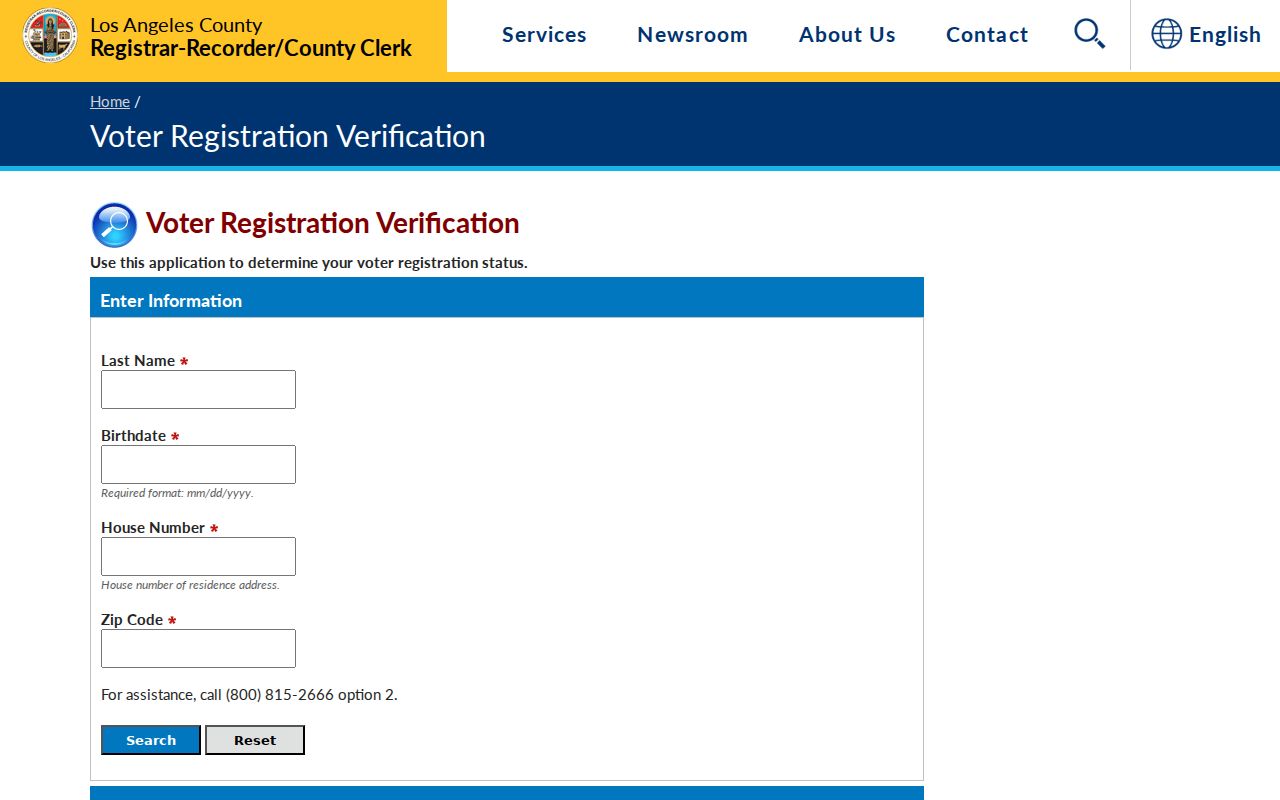
Its four-field design is a clear sign that the service verifies a known voter rather than exposing a browseable list.
Note: A failed match is not proof that no record exists; check the entered format and then call county voter assistance.
California Voter Records Field Map
California voter records and approved file products can contain useful civic facts, but access depends on purpose and the product requested. A typical record may carry the voter's name, residence and mailing address where disclosure is allowed, registration status and date, party preference, and district assignments. Participation history can show whether a person took part in an election. It never reveals a ballot choice. A personal status lookup may also report vote-by-mail or ballot status in the voter's own context.
| Voter name | Identity field in a registration record or approved file |
|---|---|
| Address | Residence and mailing address where lawful disclosure rules allow |
| Registration | Status and registration date |
| Party preference | California registration records include party preference |
| District data | Precinct and district assignments, subject to county confidentiality rules |
| Participation history | Whether the voter participated, never how the ballot was marked |
California confidentiality rule. Under Elections Code section 2194, release is limited to approved election, scholarly, journalistic, political, or governmental purposes. Driver's license numbers, Social Security numbers, signatures, and protected voter data are not released. LA County also treats the registration card's home address, phone, email, precinct number, certain state registration numbers, and prior registration details as confidential except through section 2194.
Note: Participation history can show that a voter took part in an election, but it never discloses any ballot choice.
Request La Mirada Voter History
The LA County voter information request service handles records that the online self-check does not provide. A certified affidavit or transcript costs $1.50 for a copy of the requester's own registration and $6.75 per copy for another person when public and authorized. Voter History costs $6.75 for each name searched. A Search of the Voter Registration File costs $5 for each name. These are individual record services, not the same as buying a county data file.
The request can be made in person or by mail. A mailed request must include the requester's name, address, birth date, signature, and telephone number, plus a self-addressed stamped envelope. Send it to Registrar-Recorder/County Clerk, Election Information Section, 12400 Imperial Hwy., Room 2013, Norwalk, CA 90650. Appointments may be set up to eight weeks ahead, with one person per appointment. Questions about this channel go to (800) 815-2666, option 4.
The official request page places the fee and office procedure together.
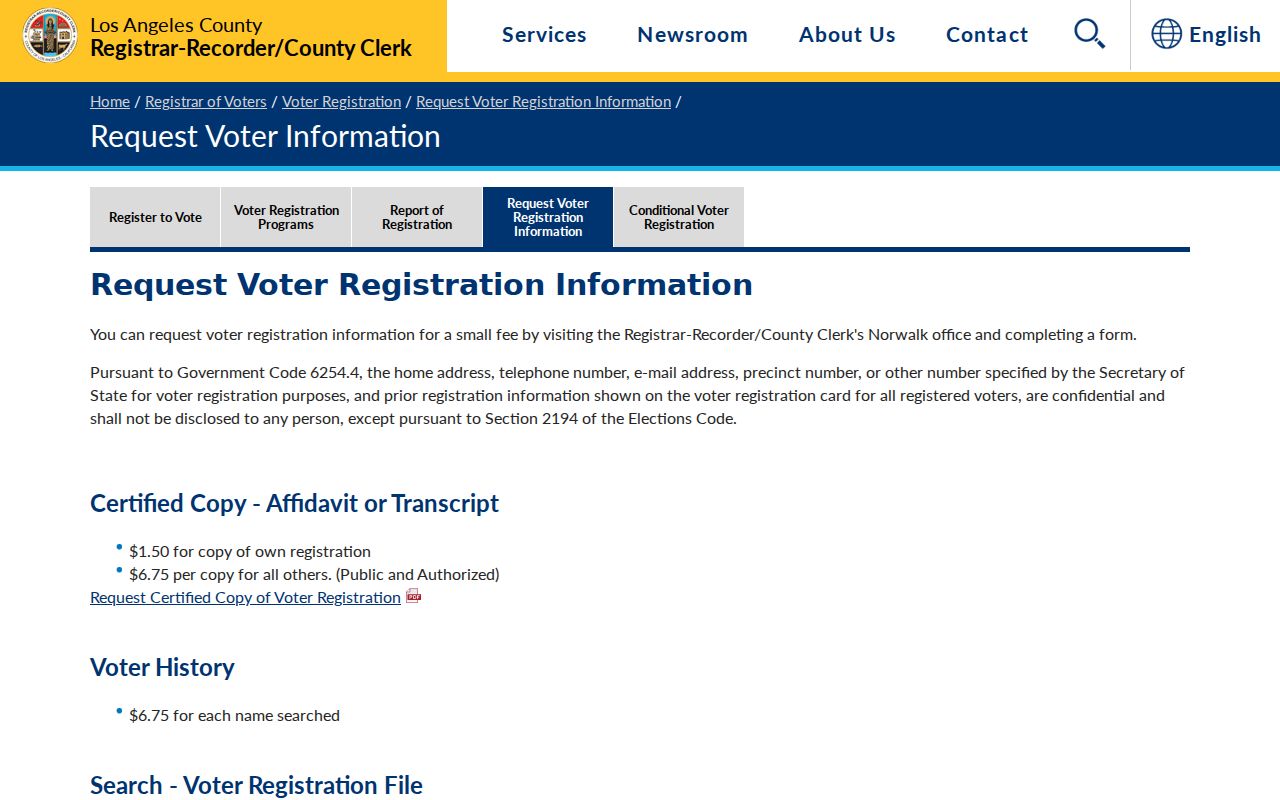
That distinction helps a requester choose an own-record copy, another authorized copy, voter history, or a name search before contacting Norwalk.
La Mirada Voter Data Products
LA County sells election data products separately from single-name requests. A Los Angeles County Voter File is listed at $146 per file. Voter, precinct, or election information files that exclude the Los Angeles County Voter Files cost $54 per file, with each added file at $39. The applicant must sign a contract with the Registrar-Recorder/County Clerk. This route fits a lawful project that needs a structured file, while the individual search channel fits a narrow record question.
The county voter data text-file page shows the listed products, charges, and contract condition.
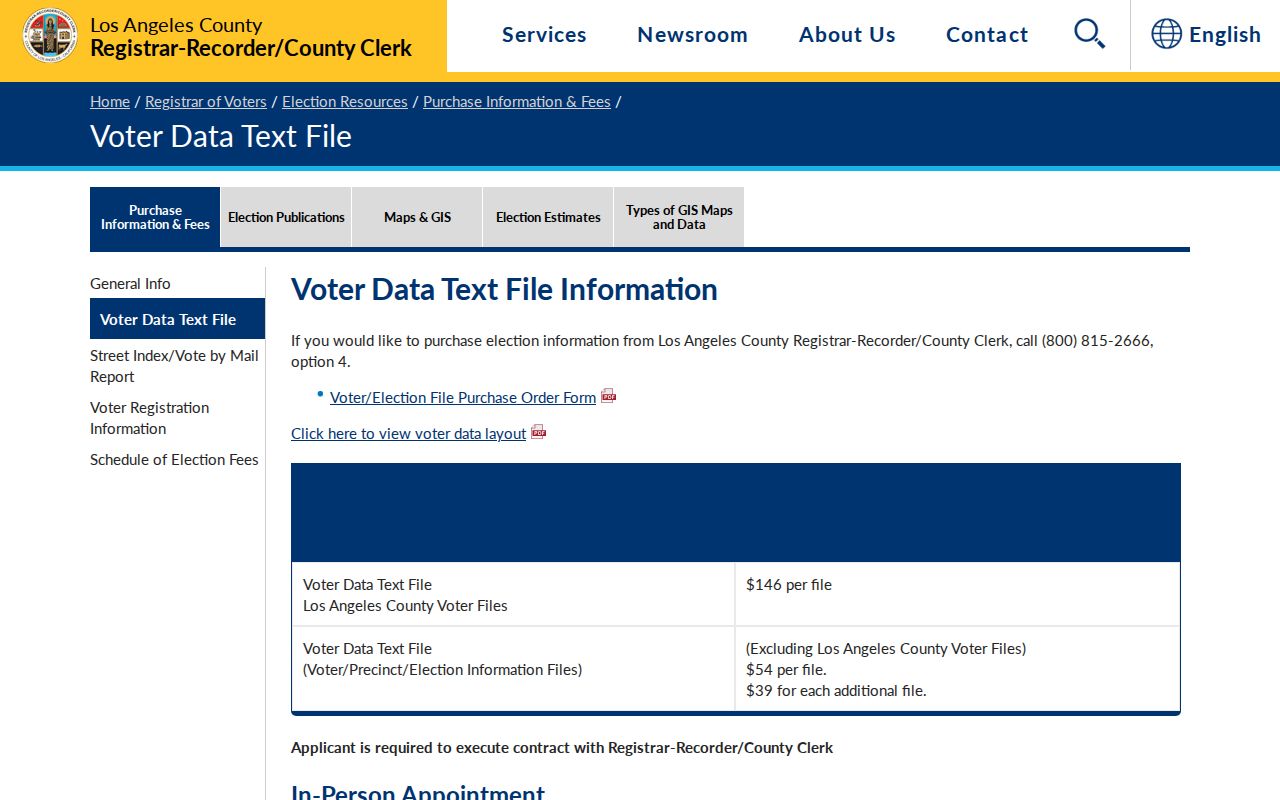
The purchase screen confirms that access to a file is a controlled request, not an open export from the self-verification tool.
La Mirada Street Index Reports
Street indexes follow another schedule. Candidates and committees pay $0.50 per thousand names for an Index to Voter. The general public may obtain it for political purposes only at $0.10 per page plus $1.60 handling per request. Voter index and vote-by-mail reports use the same per-page and handling charges, and a contract is required. These products do not turn the county status form into a public directory.
The street-index and report page records those product-specific terms.
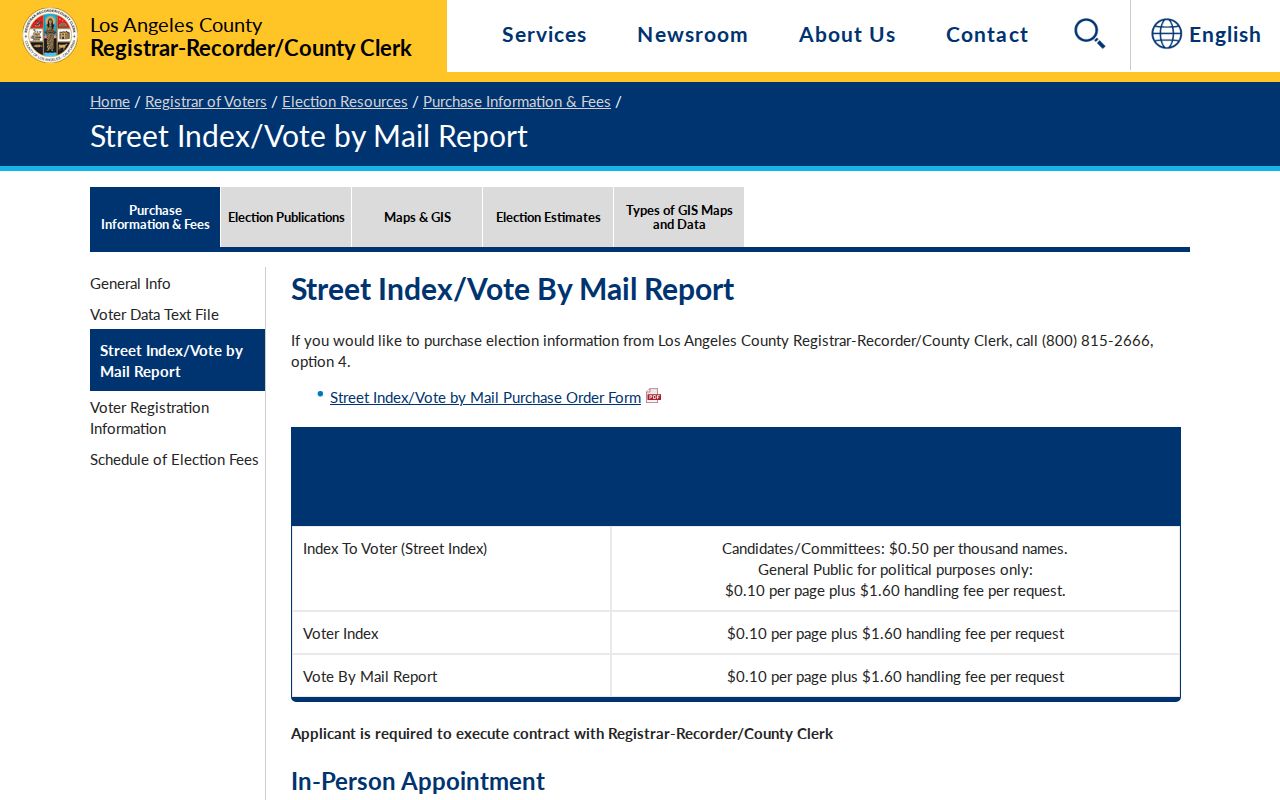
Its separate schedule shows why a requester should name the exact voter product instead of asking broadly for election records.
Note: County street-index access requires the stated purpose and contract even though the product is priced by names or pages.
Get the California Voter File
The statewide option runs through the California Secretary of State voter file request process. La Mirada records sit within the state and Los Angeles County registration systems, but an applicant must identify the data sought and certify a permitted purpose. The governing uses are election, scholarly, journalistic, political, or governmental. Commercial use is barred.
- Complete the SOS Voter File Application with applicant name, organization if any, address, phone, and email.
- Describe the statewide or specific voter registration information requested and state the approved purpose.
- Sign the security and use certification, accepting responsibility for lawful handling of the data.
- Mail the completed form to Secretary of State, 1500 11th Street, 5th Floor, Sacramento, CA 95814. The form excerpt says emailed or faxed applications are not accepted.
Voter-file access is not a waiver of privacy law. Misuse can lead to penalties, and California voter privacy notices state that commercial use is a misdemeanor. Records must never be used to stalk, threaten, or harass a person. For general government-record access outside this controlled election system, the La Mirada public records overview explains the broader California request framework.
Safe at Home Shields Voter Records
The California Safe at Home program gives qualifying participants a substitute mailing address, mail forwarding, an agent for service of process, and confidential voter registration. It serves qualifying victims and survivors, along with certain workers and public employees who fear for their safety. Participants should contact Safe at Home rather than use the usual online registration route.
Certification lasts four years. Participants must report a name or address change within seven days. The protection does not erase information that was already public, so an older document can remain visible even when a current voter address is shielded. For La Mirada research, a missing residence field may reflect a valid safety measure rather than an incomplete county record.
Note: Never infer or publish a protected address from older files when a current California record intentionally withholds it for safety.
Historical La Mirada Voter Research
No single official online index was found for historical La Mirada poll books or voter registers. The most sound fallback is to search State Archives catalogs and Los Angeles County election records, then use regional newspapers and directories to establish that a person lived in the area during a likely election year. Whittier and Los Angeles newspaper collections can add dates, addresses, civic activity, or precinct context. County archives may hold material that is not described at the city level.
The Whittier History Room offers a practical bridge when an old election register cannot be found. Its city directories span 1903 through 1977, Whittier-area telephone books span 1904 through 1948, and Haines Criss-Cross volumes run from 1972 to the present. The criss-cross books work by both name and address. None proves registration or turnout. Used with a dated county election source, though, these collections can distinguish people with similar names and show which regional label belonged to an address at the time.
Place names matter. La Mirada incorporated as Mirada Hills in March 1960 and changed its name back later that year. Earlier residents may appear under Whittier, Norwalk, Rivera, county, rancho, or other postal and regional labels. Search both Mirada Hills and La Mirada for 1960-era sources. When a historic roll cannot be located, city directories, phone books, newspapers, and county records can form a dated residence trail without claiming that the person registered or voted.
Note: A directory entry can support historic residence research, but it cannot prove that the listed person registered or cast a ballot.